
Walk into any home and the most comfortable pieces of furniture you see all have one thing in common. They are upholstered. The sofa you sink into, the armchair by the window, the padded dining chairs around the table, the headboard behind your bed. All of it is upholstery.
But when someone actually asks “what is upholstery,” most people struggle to give a complete answer. They know it has something to do with fabric and cushions, but the full picture goes much deeper than that.
This guide answers that question completely. What is upholstery, what is furniture upholstery made of, the different types of upholstery, what upholstery is used for, how to choose the right upholstery for your home, how to clean upholstery properly, and how to maintain it so it lasts for years. Everything in one place, in order, starting from the very beginning.
What Is Upholstery?
Upholstery is the craft, material, and finished result of covering furniture with soft layered materials to create comfort, structure, and visual appeal. The term refers both to the process of applying these materials and to the finished covering itself.
The word upholstery comes from the Middle English word “upholdester,” which described a craftsman who repaired and maintained soft furnishings. Over centuries, the trade evolved from basic repair work into a full construction discipline that combines woodworking, engineering, and textile craft.
Today, when people ask what is upholstery, the most accurate answer is this:
Upholstery is the complete system of soft materials applied to a furniture frame, including the padding, support layers, and outer fabric covering, that transforms a rigid structure into a functional and comfortable piece of furniture.
It is not just the fabric you see. It is everything underneath it working together.
What Is Furniture Upholstery Made Of?
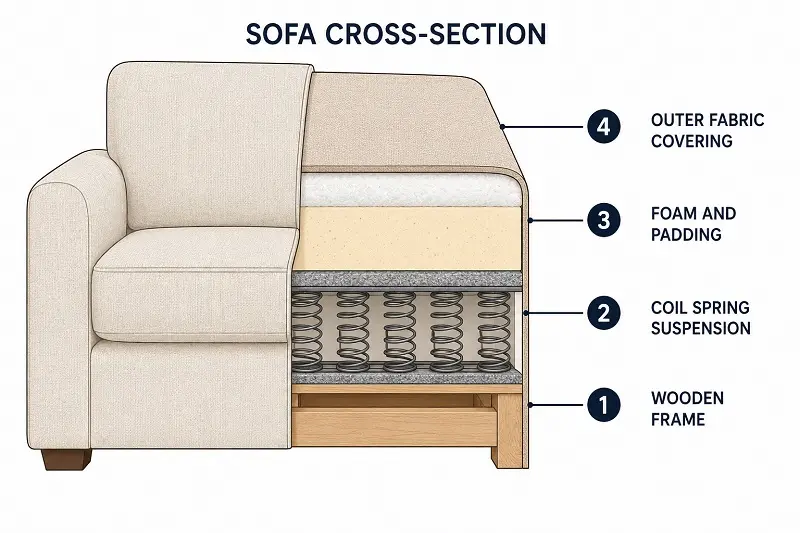
What is furniture upholstery made of at its core? A fully upholstered piece of furniture is built from four distinct layers, each with a specific role:
Layer 1: The Frame The frame is the rigid skeleton of the furniture. It is typically constructed from hardwood such as beech, oak, or ash, engineered wood like plywood or MDF, or metal. The quality and material of the frame directly affects how long the furniture will last. A hardwood frame can last for decades. A low-quality MDF frame may begin to weaken within a few years of regular use.
Layer 2: The Suspension System The suspension system sits directly on top of the frame and creates the springiness and give that makes seating comfortable. There are three main types used in furniture today:
Coil springs are individual metal springs tied together with twine across the seat base. They provide deep, responsive bounce and are considered the highest quality suspension system in traditional upholstery.
Sinuous springs, also called S-springs or no-sag springs, are continuous zigzag wire strips attached across the frame from front to back. They are flatter than coil springs and used widely in mid-range furniture because they are more cost-effective to produce.
Webbing is the simplest suspension type. It consists of interlaced strips of jute, rubber, or synthetic material stretched across the frame opening. Webbing is common in lightweight chairs and occasional seating.
Layer 3: The Padding and Filling Above the suspension system sits the padding layer. This is what determines the feel of the furniture, whether it is firm, soft, plush, or somewhere in between. Common padding materials include:
High-density foam, which is the most widely used padding material in modern furniture. Higher density foam holds its shape longer and resists compression better than low-density alternatives.
Memory foam, which responds to body heat and weight to contour around the sitter. Used in premium seating and mattress applications.
Polyester fiber, which is lightweight, hypoallergenic, and often used as a wrap around foam to add softness and a rounded appearance to cushions.
Down and feather filling, which creates an extremely soft, luxurious feel but requires regular fluffing and reshaping. Commonly used in high-end sofas and traditional furniture.
Cotton batting, which is a natural layer of compressed cotton fiber used as a topping over foam to add softness and a smooth surface under the outer fabric.
Layer 4: The Outer Fabric Covering The outer covering is the layer most people point to when they say “upholstery” in everyday conversation. It is the textile or material that forms the visible and tactile surface of the furniture. This layer can be made from dozens of different materials, each with distinct properties that affect comfort, durability, appearance, and how it needs to be cleaned.
Understanding all four layers is important because it changes how you think about cleaning and maintenance. When you clean upholstery fabric, you are not just cleaning a surface. Any moisture you apply travels downward through the layers. Excess water can reach the foam padding and remain trapped there for many hours, creating conditions that support mold growth and produce persistent musty odors inside the cushion.
What Is Upholstery Used For?

Upholstery is used wherever a hard surface needs to become soft, supportive, and visually finished. The applications span from household furniture to commercial interiors to transportation.
What Is Upholstery Used for in the Home?
In residential settings, upholstery is used across nearly every room:
Living room furniture is the most prominent use of upholstery in the home. Sofas, sectionals, loveseats, and armchairs are all upholstered pieces. The living room sofa is typically the largest single upholstered item in a household and the piece that receives the heaviest daily use.
Dining chairs use upholstery on the seat pad and often the backrest. Dining chair upholstery takes concentrated wear from repeated sitting and is frequently exposed to food and drink spills.
Bedroom furniture uses upholstery on headboards, bed bases, bedroom armchairs, and ottomans. Headboard upholstery is in direct contact with pillows, hair care products, and skin oils every night.
Home office seating uses upholstery on desk chairs, task chairs, and any additional seating. Office chairs are among the most heavily used upholstered items in a home because they support a person’s weight for hours at a stretch.
Window seats and bay window benches are built-in upholstered seating sections often found in older homes or custom-built interiors.
Ottomans and footstools receive both foot resting pressure and occasional sitting weight, making them prone to compression over time.
Chaise lounges and daybeds are large horizontal upholstered pieces used for lounging and reading. They require the same level of care as sofa upholstery.
What Is Upholstery Used for Commercially?
In commercial environments, upholstery is used in:
Restaurant and cafe seating, where booth benches, bar stools, and dining chairs use upholstery designed for high turnover, easy cleaning, and resistance to food stains.
Hotel lobbies and guest rooms, where upholstered furniture is selected for appearance, durability under heavy guest use, and compliance with fire safety standards.
Healthcare facilities, where medical-grade upholstery uses antimicrobial, fluid-resistant fabrics that can be sanitized repeatedly without degrading.
Office environments, where task chairs, conference seating, reception sofas, and lounge furniture all use professional-grade upholstery fabrics.
Theaters and cinemas, where rows of upholstered seats use high-density foam and heavy-duty woven fabrics designed for years of continuous use.
Transportation, where car seats, airplane seats, train carriages, and bus seating all use specialized upholstery engineered for safety, durability, and easy maintenance in high-traffic conditions.
Types of Upholstery

Understanding the types of upholstery available helps you make better decisions when buying furniture, selecting replacement fabric, or figuring out the right cleaning approach for what you already own.
Upholstery types can be categorized in two ways: by the furniture category it covers, and by the material used on the outer surface.
Types of Upholstery by Furniture Category
Sofa and Sectional Upholstery: Sofa upholstery is the most complex type in residential use. A sofa combines multiple upholstered sections in one piece, including the seat cushions, seat base, backrest, armrests, and base panel. Each section may accumulate different types of soil and require slightly different attention during cleaning. The armrests collect body oil. The seat base collects crumbs and debris. The backrest collects dust and airborne particles.
Chair Upholstery: It covers armchairs, accent chairs, dining chairs, and occasional chairs. Chair upholstery often uses more decorative or premium fabrics than sofas because the smaller surface area makes the cost of higher-quality materials more manageable.
Ottoman and Footstool Upholstery: Ottoman upholstery covers the entire exterior of the piece. Ottomans function both as footrests and occasional seating, meaning the top surface receives compression from both shoes and sitting weight.
Headboard and Bed Frame Upholstery: Headboard upholstery is applied to the face of the headboard panel. It is in contact with pillows and hair every night. Upholstered bed frames extend the fabric covering further around the base of the bed.
Outdoor Furniture Upholstery: Outdoor upholstery is specifically engineered for weather resistance. Patio sofa cushions, outdoor chair cushions, garden bench pads, and outdoor sectional covers all use fabrics and foam designed to resist UV fading, moisture absorption, mold, and mildew. The cleaning approach for outdoor upholstery differs meaningfully from indoor methods.
Dining Chair Upholstery: Dining chair upholstery sits at a unique intersection between decorative and practical. It is seen daily, used multiple times a day, and exposed to food spills regularly. Performance fabrics and leather are popular choices for dining chairs because of their ease of cleaning.
Automotive and Marine Upholstery: Car seat upholstery uses leather, faux leather, or woven fabric over molded foam. Marine upholstery uses vinyl and marine-grade materials rated for constant moisture and UV exposure.
Types of Upholstery by Material
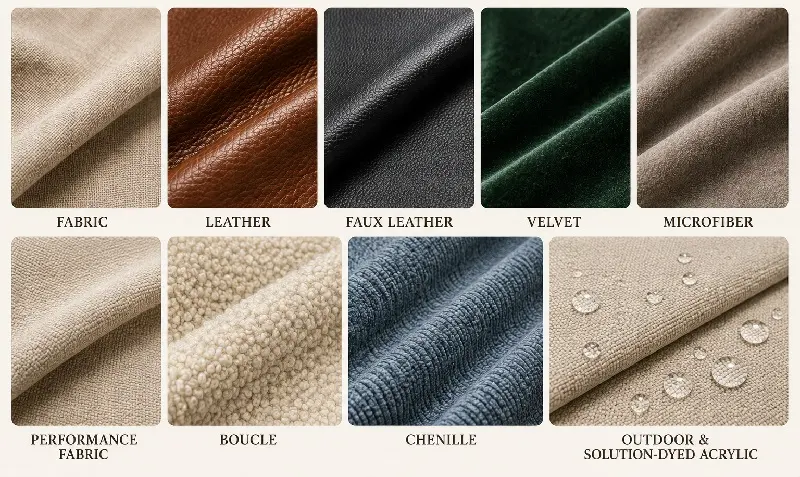
This is the most practically useful way to understand upholstery types because the material determines the cleaning method, durability, and maintenance requirements.
Fabric Upholstery: Fabric upholstery is the broadest category and covers all woven, knitted, and non-woven textile coverings. It includes cotton, linen, wool, velvet, chenille, bouclé, microfiber, polyester blends, and many more. Fabric upholstery is the most common type found in homes because of its wide variety, comfort in different climates, and availability across all price points.
Leather Upholstery: Genuine leather upholstery uses treated animal hide, most commonly cowhide. It is highly durable, develops character over time through natural patina, and is relatively simple to clean. Leather requires periodic conditioning to prevent drying and cracking.
Within genuine leather there are several grades. Full grain leather retains the natural surface of the hide and is the most durable and most expensive. Top grain leather is sanded and treated to create a more uniform surface. Split leather comes from the lower layers of the hide and is less durable. Bonded leather uses scraps of leather pressed together with adhesive over a fabric backing and is the lowest quality option that still uses the word leather in its description.
Faux Leather Upholstery: Faux leather, also called vegan leather, synthetic leather, or PU leather, uses a polyurethane or PVC coating over a fabric backing. It mimics the appearance of real leather at a lower cost and is fully synthetic. Faux leather resists moisture better than genuine leather but tends to peel or crack with heavy use over time, particularly where the surface flexes repeatedly.
Velvet Upholstery: Velvet upholstery uses a cut pile weave that creates a dense, soft surface with a visible nap direction. The nap catches light differently from different angles, giving velvet its distinctive shimmering quality. Velvet is luxurious in appearance but one of the more demanding upholstery types to maintain because the pile can crush, mark, or flatten permanently with rough handling.
Microfiber Upholstery: Microfiber upholstery uses ultra-fine synthetic fibers, typically polyester or nylon, woven into a very dense fabric. The result is a soft, suede-like surface that resists many surface stains. Microfiber is durable, hypoallergenic, and popular in family homes. Its fine weave structure traps oily residues, so cosmetic stains and cooking oil splashes often require solvent-based treatment.
Performance Fabric Upholstery: Performance upholstery fabrics are engineered textiles designed specifically for high-demand environments. They are treated or constructed to resist staining, moisture, UV fading, pilling, and abrasion better than standard textiles. Brands such as Crypton, Sunbrella, Revolution, and Perennials produce performance fabrics used in both residential and commercial upholstery. Performance fabrics are increasingly popular in homes with children and pets because many can be cleaned with diluted bleach without damage.
Boucle Upholstery: Bouclé upholstery uses a looped yarn structure that creates a distinctive textured, nubby surface. It has become a dominant trend in contemporary furniture design. The looped construction is visually interesting and pleasant to touch but is highly susceptible to snagging. Any cleaning method involving friction can pull the loops and permanently distort the fabric surface.
Chenille Upholstery: Chenille upholstery uses a pile yarn that creates a thick, ribbed, soft texture. It is warm, comfortable, and available in rich colors. Like velvet, chenille can shed or pull if subjected to aggressive cleaning. Spot treatment with minimal moisture and gentle blotting is the appropriate approach.
Outdoor and Solution-Dyed Acrylic Upholstery: Outdoor upholstery fabrics are made from solution-dyed acrylic, polyester, olefin, or vinyl. Solution-dyed means the color is added to the fiber during production rather than applied to the surface afterward, which makes these fabrics significantly more resistant to UV fading. They are also engineered to dry quickly after moisture exposure and resist mold and mildew naturally.
Upholstery Fabric Comparison Table
| Fabric Type | Texture and Appearance | Durability Rating | Best Used For | Cleaning Sensitivity |
| Cotton | Soft, breathable, matte finish | Medium | Casual sofas, armchairs, pillows | Absorbs moisture quickly, can shrink with heat |
| Linen | Natural, slightly textured, cool | Medium | Accent chairs, light-use pieces | Wrinkles easily, sensitive to soaking |
| Wool | Warm, soft, slightly textured | High | Formal chairs, quality sofas | Shrinks with heat, alkaline cleaners damage fiber |
| Velvet | Plush, napped, light-reflective | Medium | Statement sofas, bedroom chairs | Crushes easily, no scrubbing, minimal moisture |
| Microfiber | Suede-like, very dense, soft | Very High | Family rooms, pet-friendly homes | Traps oil, may need solvent for grease stains |
| Polyester | Smooth or textured, wide variety | High | Everyday sofas, dining chairs | Handles most cleaners but retains oily residue |
| Chenille | Ribbed, thick, warm | Medium | Lounge chairs, casual sofas | Sheds and pulls if scrubbed |
| Leather (Genuine) | Smooth, firm, develops patina | Very High | Classic sofas, office chairs | Needs conditioning, cracks if over-dried |
| Faux Leather | Leather look, softer feel | Medium | Budget sofas, dining chairs | Surface peels with solvents or rough cleaning |
| Boucle | Looped, textured, modern | Low to Medium | Accent chairs, designer sofas | Extremely easy to snag, friction causes damage |
| Performance Fabric | Varies, engineered surface | Very High | Family homes, commercial use | Very easy, many are bleach-safe |
| Outdoor Acrylic | Slightly matte, weather-resistant | Very High outdoors | Patio cushions, garden furniture | Mild soap and water, air dry only |
How to Choose the Right Upholstery
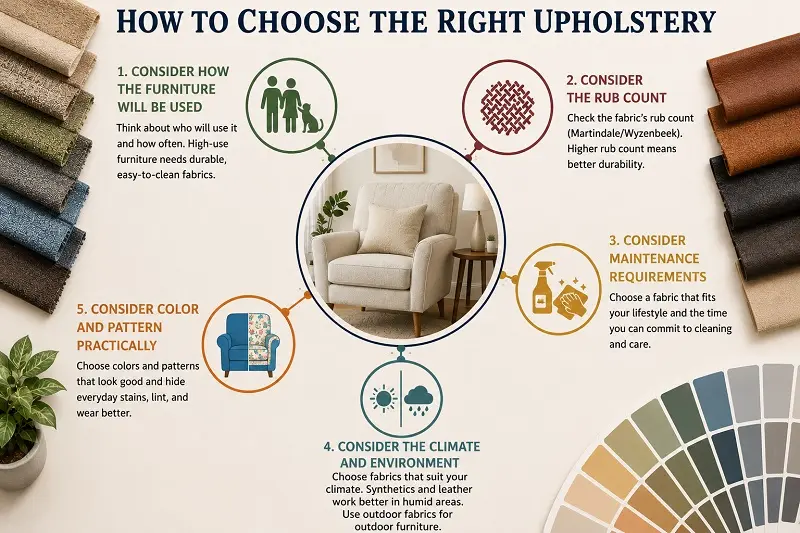
Choosing the right upholstery for a piece of furniture or for a reupholstery project involves balancing several factors at the same time. Making the right choice up front saves you the frustration of replacing or repairing furniture earlier than necessary.
Consider How the Furniture Will Be Used
The first question to ask is how much use the piece will receive and who will be using it.
A sofa in a busy family room with children and pets needs a completely different fabric than an accent chair in a formal sitting room that receives guests twice a month. High-use pieces need high-durability fabrics with strong abrasion resistance and easy cleaning properties. Performance fabrics, microfiber, and leather are the most practical choices for heavy daily use.
For pieces that are primarily decorative or used occasionally, you have much more freedom to choose fabrics based on appearance, texture, and feel, including delicate options like velvet, bouclé, or linen.
Consider the Rub Count
Rub count, also called the Martindale rating or Wyzenbeek count, depending on which testing standard is used, measures how many times a fabric can be rubbed before it shows visible wear. This is the most objective measure of upholstery fabric durability available.
General guidance on rub count ratings:
| Rub Count | Durability Level | Best Application |
| Under 10,000 | Decorative use only | Cushion covers, occasional decorative pieces |
| 10,000 to 15,000 | Light residential use | Formal rooms, low-traffic furniture |
| 15,000 to 25,000 | General residential use | Standard home sofas and chairs |
| 25,000 to 30,000 | Heavy residential use | Family rooms, frequently used pieces |
| 30,000 to 100,000 | Commercial grade | Offices, restaurants, waiting rooms |
| Above 100,000 | Heavy commercial grade | Healthcare, transportation, and cinemas |
Consider Maintenance Requirements
Every fabric type comes with a realistic maintenance expectation. If you know you will not have the time or patience for high-maintenance cleaning routines, choose a fabric that suits your lifestyle honestly.
Leather and performance fabrics are the lowest maintenance options for daily-use furniture. Microfiber and polyester blends are close behind. Natural fibers like linen and cotton look beautiful but demand more careful and regular attention. Velvet and bouclé are the highest maintenance options and should be reserved for pieces that will not see daily heavy use.
Consider the Climate and Environment
Natural fibers like cotton, linen, and wool are breathable and comfortable in temperate climates but absorb moisture in humid environments and can develop mildew if not properly maintained.
Synthetic fabrics and leather perform better in humid environments because they do not absorb moisture the same way. For outdoor furniture upholstery in any climate, only purpose-built outdoor fabrics should be used.
Consider Color and Pattern Practically
Lighter colors show staining more visibly but make a room feel more spacious and bright. Darker colors conceal everyday soiling better but show lint, pet hair, and fading more noticeably over time.
Patterned fabrics help camouflage everyday marks and crumbs between cleaning sessions. Solid colors in medium tones tend to offer the best balance of appearance and practical maintenance for busy households.
Understanding Upholstery Cleaning Codes
Before any cleaning product touches your upholstery, there is one non-negotiable first step that applies to every piece of upholstered furniture, regardless of how expensive or how ordinary it is.
Find the care label.
The care label is typically attached to the underside of a removable cushion, underneath the sofa or chair base, or on a tag connected to the frame. It carries a cleaning code, a single letter or a combination of letters, that tells you exactly what type of cleaning agent is safe for that specific fabric.
Using the wrong cleaner based on this code can cause permanent water rings, shrinkage, dye bleeding, or surface distortion that no amount of subsequent treatment can reverse.
| Cleaning Code | What It Means | Safe to Use | Never Use |
| W | Water-based cleaners are safe | Mild soap and water solution, water-based upholstery cleaners, and steam on most W fabrics | Solvent-based dry-cleaning chemicals |
| S | Solvent-based cleaners only, no water | Dry-cleaning solvents only | Water, steam, any water-based solution |
| WS | Both water and solvent cleaners are safe | Either a mild soap solution or a solvent-based cleaner | Oversaturation with either type |
| X | Vacuum and brush only, no liquids | Dry vacuuming, soft brush | Any liquid including water, steam, solvent |
A piece of furniture with an X code is not beyond cleaning. It means liquid-based home cleaning is not appropriate for it. Professional dry-cleaning services using specialist equipment can still achieve excellent results on X-coded upholstery.
If your furniture has no label or the label is no longer readable, treat the fabric as an S code to be safe. Test any product on a completely hidden section before using it on a visible surface.
How to Clean Upholstery Properly
This is the section most people come looking for, and it is where most online guides let readers down by giving generic advice that ignores fabric types, stain categories, and proper technique. How to clean upholstery properly is a process, not a single action.
The method below covers how to clean upholstery on a fabric sofa, armchair, dining chair, headboard, ottoman, and most other indoor upholstered pieces. There is a separate section below for outdoor upholstery.
Everything You Need Before You Start
Equipment:
A vacuum cleaner with an upholstery brush attachment. This is the most critical tool in the entire process. No other item replaces it.
A crevice tool attachment for the vacuum. This reaches into seams and gaps where debris concentrates most heavily.
Clean white microfiber cloths. Never use colored cloths or sponges. Dye from colored fabric transfers to light upholstery when wet.
A soft-bristle brush for working cleaning solution gently into fibers without damage.
A spray bottle for applying a solution in a fine, controlled mist.
A clean, dry towel for blotting and drying.
Cleaning Solutions:
For W and WS coded fabrics: two drops of mild dish soap in one cup of warm water. Beat lightly to create a foam.
For odor treatment: plain baking soda, applied dry.
For set-in stains and bacteria: equal parts white vinegar and cold water.
For S-coded fabrics: a dry-cleaning solvent from a hardware or cleaning supply store.
For pet stains: an enzyme-based upholstery cleaner.
Step 1: Check the Cleaning Code and Know Your Fabric
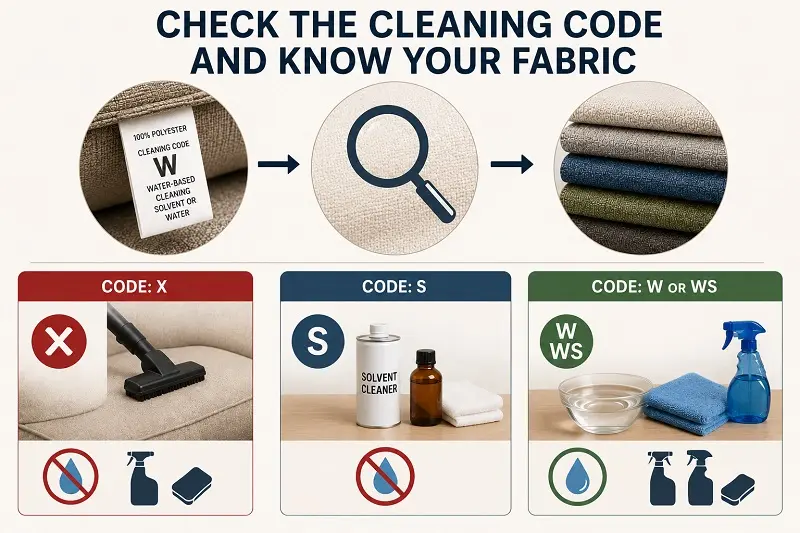
Before doing anything else, locate the care label and note the cleaning code. Also identify the fabric type if the label lists it.
If the code is X, stop. Vacuum the surface lightly and call a professional for anything beyond that.
If the code is S, set aside all water-based solutions. Everything in the cleaning process from this point uses solvent only.
If the code is W or WS, proceed with the full process below.
This step takes two minutes. Skipping it and discovering the wrong approach was used on a visible section of the furniture is a far more expensive and time-consuming outcome.
Step 2: Remove All Cushions and Vacuum the Entire Surface
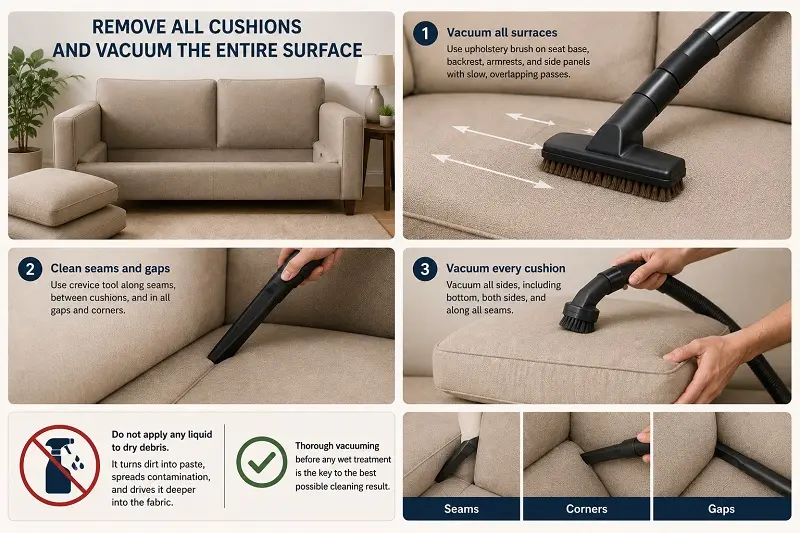
Remove every cushion from the sofa or chair. Take off any throws, cushion covers, or fitted covers.
Attach the upholstery brush to the vacuum and work across every surface using slow, overlapping passes. Cover the full seat base, the entire backrest, both armrests, and the side panels.
Switch to the crevice tool and run it carefully along all seams, between the seat base and the armrests, and into all the gaps and corners where the brush cannot lie flat. These seam areas hold the highest concentrations of crumbs, pet hair, skin cells, and fine dust in the entire piece of furniture.
Turn each cushion over and vacuum every face, including the bottom, both sides, and along all seam edges. Debris accumulates on every surface of a cushion, not only the top.
This step is not optional and cannot be shortened or replaced. Applying any liquid to dry debris on the upholstery surface turns it into a paste that spreads the contamination across a wider area and embeds it deeper into the fabric. Thorough vacuuming before any wet treatment is the single action that most determines the quality of the final result.
Step 3: Deodorize with Baking Soda
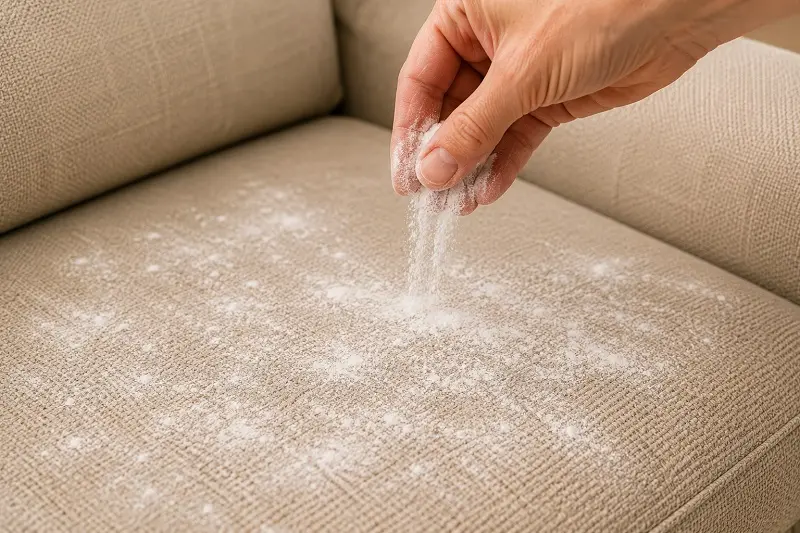
With vacuuming complete, sprinkle baking soda evenly and generously across the entire fabric surface. Use approximately one to two tablespoons per seat section as a rough guide.
Leave it undisturbed for a minimum of 20 minutes. For furniture with noticeable or persistent odors, leaving it for an hour or overnight significantly improves the result. Baking soda works by absorbing the odor-causing organic particles that are present inside the fabric fibers and the upper layer of the padding. Because it is applied dry, there is no risk of over-wetting.
After the waiting period, vacuum up all the baking soda thoroughly. The furniture should smell noticeably fresher at this point before any wet cleaning has begun.
Step 4: Spot Test Before Any Wet Cleaning
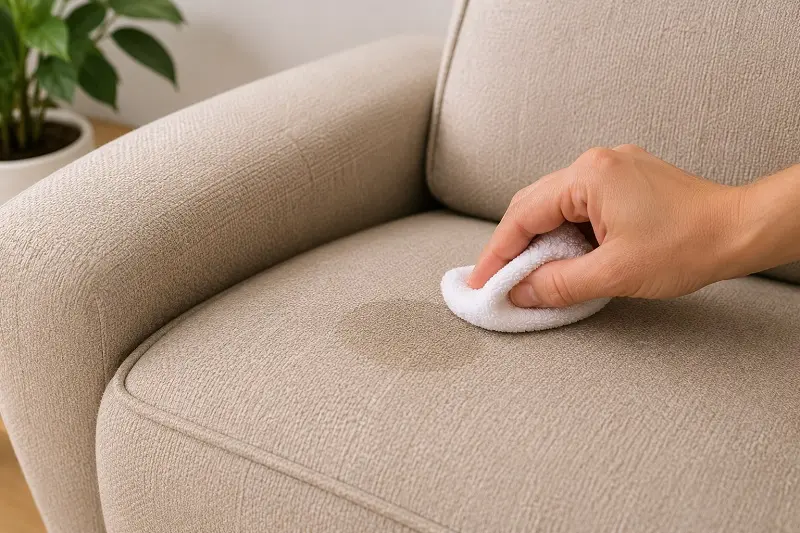
Apply a small amount of your chosen cleaning solution to a completely hidden area of the furniture. The underside of a loose cushion, the back panel behind the sofa, or the inner face of an armrest skirt are ideal locations.
Apply the solution, wait 10 full minutes, and examine the test area carefully for any color bleeding, texture change, fabric stiffening, shrinkage, or visible discoloration. If nothing has changed, the solution is safe to use on the main surfaces.
If any change appears, switch to a milder or different solution and test again before proceeding.
This check costs 10 minutes. Discovering a problem on a hidden section is inconvenient. Discovering it on the center seat cushion after treating the whole sofa is a much larger problem.
Step 5: Treat Each Stain by Its Type
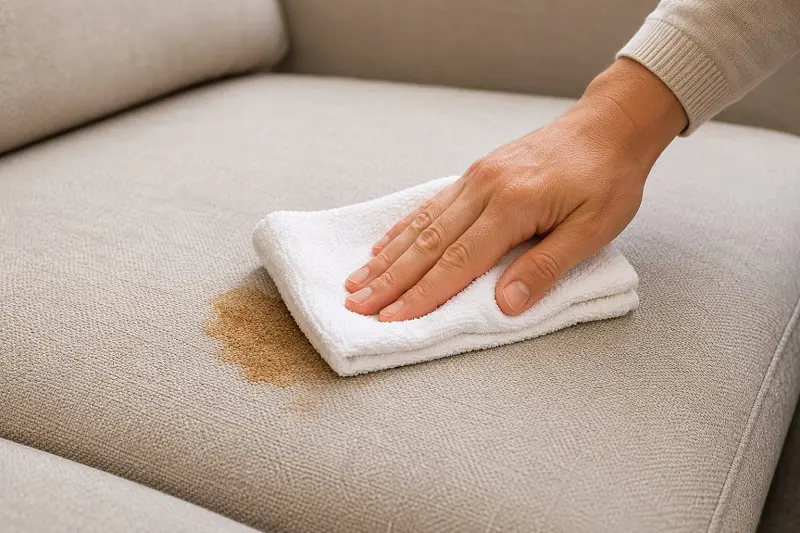
Different stains bond with upholstery fibers through different chemical mechanisms. Applying the wrong treatment to a specific stain type either does nothing or actively makes the situation worse by spreading the stain, pushing it deeper, or locking it more permanently into the fiber.
Food and Drink Stains: Coffee, Tea, Juice, Wine, Sauce
For any fresh spill, blot immediately with a clean dry white cloth. Press the cloth down firmly and lift it straight up. Repeat with clean sections of cloth until no more liquid transfers.
Never rub a fresh spill. Rubbing spreads the liquid outward, widening the stained area, and forces it deeper into the fiber layers simultaneously.
Once the excess liquid is absorbed, apply the mild soap and water solution to a clean cloth and dab the stained area, working from the outer edge of the mark toward the center. This inward direction prevents the stain from spreading into a ring pattern around its edges.
Continue with clean sections of cloth until the stain lifts. Finish by blotting the area with a cloth dampened with plain water to remove soap residue, then blot dry with a dry towel.
Grease and Oil Stains: Cooking Oil, Butter, Body Lotion, Cosmetics
Water does not dissolve oil at a molecular level. Applying water to an oil stain moves the grease sideways across the fabric surface rather than removing it.
For a fresh oil stain, apply baking soda or cornstarch directly onto it first. Leave it for 15 minutes to absorb as much of the surface oil as possible, then vacuum it away carefully.
For W and WS coded fabric, follow the baking soda step with a small amount of the mild dish soap solution applied by blotting. Dish soap contains surfactants that help break down grease.
For S-coded fabrics and microfiber upholstery, solvent-based treatment is significantly more effective on oil-based staining than any water-based method.
Pet Stains and Odors
Pet stains contain proteins, ammonia, and uric acid compounds that absorb into upholstery fibers and continue releasing odor particles even after the visible mark has been cleaned away. This is why furniture that has been treated for a pet stain with standard soap can look clean but still smell within a day or two.
An enzyme-based upholstery cleaner is the correct and only genuinely effective solution for pet stains. Enzyme cleaners contain biological compounds that break down the organic proteins at a molecular level rather than masking or temporarily suppressing the odor. Apply according to product instructions, allow the required dwell time, blot clean, and allow the area to air dry completely before assessing whether a second treatment is needed.
Ink and Dye Transfer Stains
Do not apply water to an ink stain before testing. Water spreads ink across upholstery fabric rapidly.
Apply rubbing alcohol or a solvent-based cleaner to a clean white cloth and dab lightly from the outer edge of the mark toward the center using small blotting motions. Change to an unused section of cloth after every few dabs to avoid transferring the lifted ink back onto the fabric.
Set-In and Dried Stains
For stains that have dried and formed a stronger bond with the fibers, a solution of equal parts white vinegar and cold water helps loosen the bond without introducing harsh chemicals. Apply it to a cloth rather than directly to the fabric, dab onto the stain, and leave it for two to three minutes. Blot with a plain water-dampened cloth, then blot dry.
Repeat the process if needed rather than increasing the amount of liquid applied in a single attempt.
Stubborn Deep Stains
For stains that do not respond to home treatment after two or three careful attempts, stop. Repeated unsuccessful attempts weaken the fabric fibers and may spread the contamination. At this point, professional spot treatment is the more effective and ultimately more economical choice.
Step 6: Clean the Full Surface Systematically
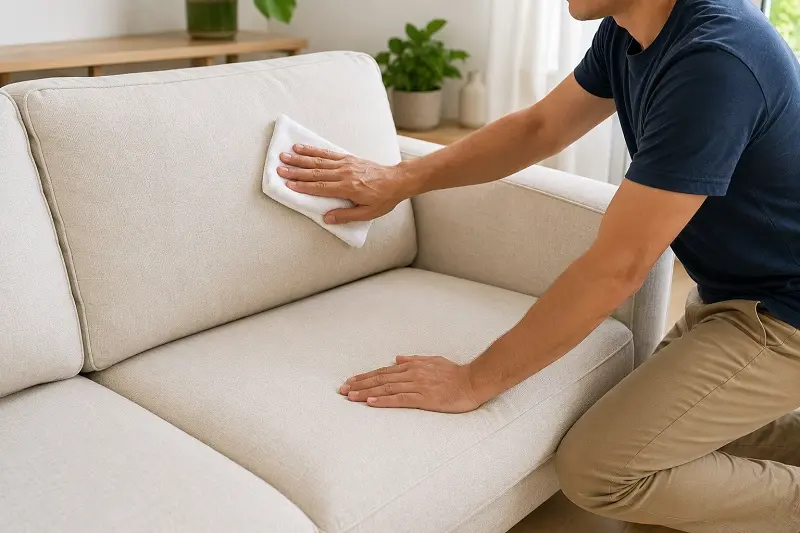
Once individual stains are treated, clean the entire piece surface-by-surface.
For W and WS coded upholstery, dip a clean white microfiber cloth into the soap solution and wring it out until the cloth is damp but not wet. There should be no liquid dripping from it. Wipe the fabric in small overlapping sections using smooth, even strokes.
Work from the top of the piece downward and from one side to the other. This systematic approach ensures you do not re-contaminate sections already cleaned.
The cloth must remain damp, never wet. If you can feel the fabric becoming saturated, you are applying too much liquid. The goal is cleaning the surface fiber layer, not soaking the material.
For S-coded upholstery, apply the solvent-based cleaner to a clean cloth and work in the same systematic pattern. Never apply solvent directly to the fabric surface. Work in a well-ventilated space and keep the area away from open flames.
Step 7: Rinse Away Cleaning Residue
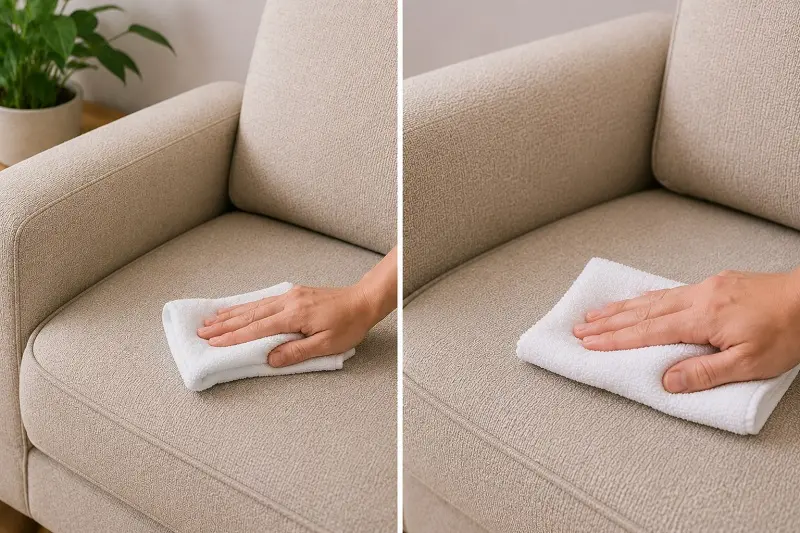
After completing the surface clean, go over the treated areas one more time with a clean cloth dampened with plain water. This removes soap or cleaning solution residue from the fabric.
Cleaning residue that dries inside upholstery fiber attracts new soil faster than untreated fabric would. This is the reason furniture that has been cleaned can sometimes appear to get dirty faster than it did before. The residue left behind is acting as a magnet for new particles.
Blot the surface afterward with a dry clean towel to remove as much moisture as possible.
Step 8: Dry the Upholstery Properly
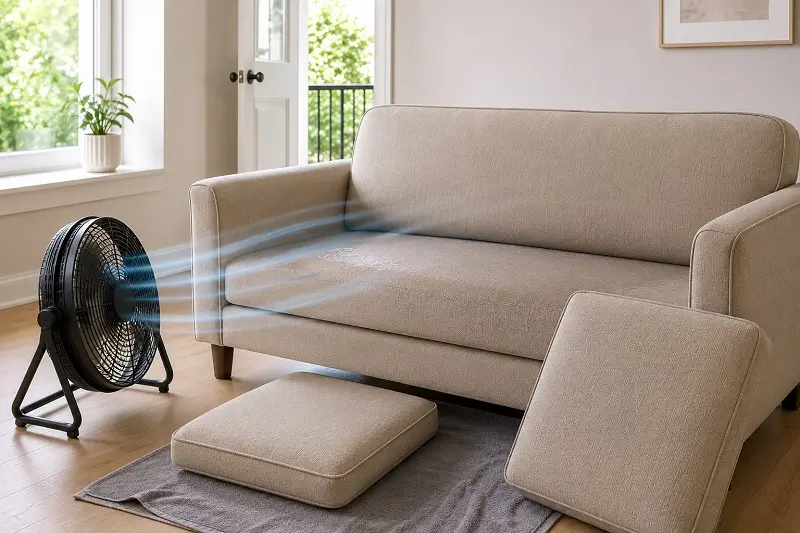
Proper drying is as important as any cleaning step. It is also where many home cleaning efforts create new problems by not allowing enough time or airflow.
Open windows and doors to increase ventilation. Position a portable fan to direct airflow across the cleaned surface. Allow the furniture to air dry completely before replacing cushions, adding covers, or using the piece.
Avoid using a hair dryer, placing the furniture in direct sunlight, or using any concentrated heat source on natural fiber fabrics. Heat causes cotton, linen, and wool upholstery to shrink and can cause dyes to fade unevenly. Low heat is generally safe for synthetic fabrics like polyester and microfiber.
Do not place cushions back on the sofa until the foam inside them is fully dry. Foam holds moisture long after the surface fabric feels dry to the touch. Furniture used before the foam is dry compresses the remaining moisture deeper into the padding and creates the ideal environment for mold growth and musty odors that are very difficult to remove afterward.
How to Clean Specific Upholstery Types
How to Clean Fabric Upholstery
A fabric sofa is the most commonly cleaned upholstered item in any home. Follow the full eight-step process above. Pay particular attention to the armrests, which accumulate body oil and hand lotion residue faster than any other section, and the seat base, which collects crumbs and debris between cushions.
For routine maintenance between deep cleans, a quick weekly vacuum of the seat surface, cushion sides, and arm areas makes each full cleaning session significantly easier.
How to Clean Leather Upholstery
Leather upholstery should never be cleaned with water-based soap solutions used on fabric. Use a cleaner specifically formulated for leather, applied to a soft cloth rather than directly to the surface.
Wipe the leather surface gently with the cleaner, working in small sections. Follow with a dry cloth to remove any excess. After cleaning, apply a leather conditioner to keep the material supple and prevent cracking. Leather that is cleaned without conditioning afterward dries out gradually and begins to crack along stress lines.
Never use household cleaners, alcohol, bleach, or acetone on leather upholstery. These strip the natural oils and surface treatment from the hide.
How to Clean Velvet Upholstery
Velvet requires the gentlest possible approach. Use a soft brush attachment on the vacuum at its lowest suction setting. For surface marks, use a barely damp white cloth and press lightly without rubbing. Allow to air dry and then use a soft velvet brush to restore the nap direction.
Never scrub velvet. Never steam clean velvet without checking the care code first. Never press a hot iron against velvet. All of these actions can crush or permanently flatten the pile.
How to Clean Microfiber Upholstery
Microfiber upholstery marked with a W or WS code can be cleaned with the soap and water method. Microfiber upholstery marked with an S code requires a solvent such as rubbing alcohol or a dry-cleaning solvent.
For S-coded microfiber, spray the solvent lightly onto a clean white cloth, not directly onto the fabric, and wipe in small circular motions. As the solvent evaporates, it lifts the soil with it. Use a soft brush to restore the texture of the microfiber once dry.
How to Clean Outdoor Upholstery
Outdoor furniture upholstery including patio sofa cushions, garden chair pads, and outdoor sectional covers is designed for greater moisture tolerance than indoor fabrics and can handle more water during cleaning.
Remove cushion covers with zippers and check the care label for machine washability. Many outdoor covers can be washed on a cold gentle cycle and air dried flat.
For non-removable covers, mix mild dish soap with warm water in a bucket. Use a soft brush to work the solution into the fabric surface using gentle circular motions. Rinse thoroughly with a garden hose or clean water. Stand cushions upright at an angle so water can drain from the foam interior as they dry. Never store outdoor cushions until they are completely dry.
For mold or mildew on outdoor upholstery, a solution of equal parts white vinegar and water applied to the affected area and left for 10 minutes before gentle scrubbing and rinsing is effective in most cases. For heavily mold-affected pieces on solution-dyed acrylic fabrics, a diluted bleach solution of one part bleach to ten parts water can be used. Always check the care label before using bleach.
Upholstery Cleaning Guide by Fabric Type
| Fabric | Cleaning Code Typically | Best Cleaning Method | What to Avoid |
| Cotton | W or WS | Mild soap and warm water, gentle blotting | High heat drying, over-wetting, scrubbing |
| Linen | W or WS | Minimal water, damp white cloth, blot and air dry | Soaking, rubbing, heat |
| Wool | W or WS | pH-neutral cleaner, very light moisture | Alkaline cleaners, hot water, agitation |
| Velvet | S or WS | Light barely-damp cloth, soft brush to restore nap | Scrubbing, steam, soaking |
| Microfiber | W, S, or WS | Depends on code: soap solution or rubbing alcohol | Rubbing when wet, excess water |
| Polyester | W or WS | Soap and water, blot dry | Prolonged soaking, very hot water |
| Chenille | W or WS | Very gentle damp blotting, minimal pressure | Any scrubbing, pulling on fibers |
| Genuine Leather | W or S | Leather-specific cleaner followed by conditioner | Water-soaking, household cleaners, alcohol |
| Faux Leather | W or WS | Damp cloth with mild soap, gentle wipe | Solvents, abrasive pads, rough scrubbing |
| Bouclé | W or WS | Barely damp white cloth, extreme gentleness | Any friction-based cleaning, rough cloths |
| Performance Fabric | W or WS | Usually water and mild soap, many are bleach-safe | Solvent on water-only coded performance fabric |
| Outdoor Acrylic | W | Soft brush with mild soap, rinse thoroughly, air dry | Machine drying, heat, bleach on most types |
Upholstery Maintenance Guide
How to clean upholstery properly is only part of the picture. Maintaining upholstery between cleaning sessions determines how long the furniture looks good, how often deep cleaning is needed, and ultimately how many years the piece lasts before needing reupholstering or replacement.
Weekly Upholstery Maintenance
Vacuum all upholstered surfaces lightly once a week using the upholstery brush attachment. This single habit removes loose dust, skin cells, and surface debris before they settle into the fiber layers and become embedded. It takes three to five minutes per piece and is the most effective maintenance action available.
Every One to Two Weeks
Rotate and flip removable cushions if they are reversible. This distributes compression wear evenly across all surfaces and prevents any single spot from developing a permanent indentation or becoming visibly more worn than the rest of the piece.
Every One to Two Months
Apply baking soda across the full fabric surface, leave it for at least 20 minutes, and vacuum it away. This routine deodorizing treatment keeps odors from building up inside the padding layers to the point where they become persistent and difficult to address.
Check armrests and headrests for early signs of body oil accumulation. A barely damp cloth wiped across these high-contact areas during regular cleaning prevents the gradual buildup that eventually causes discoloration.
Every Two to Three Months
Do a full surface clean using the soap and water method for W and WS coded fabrics or the appropriate solvent method for S-coded pieces. This removes body oil, atmospheric dust, and general surface soiling that vacuuming alone cannot lift.
Every Three to Six Months
Perform a thorough deep cleaning session that includes the full eight-step process described above: cushion removal, comprehensive vacuuming, baking soda treatment, spot testing, stain treatment, full surface cleaning, rinsing, and complete drying.
Once a Year
Schedule a professional upholstery cleaning. Professional cleaners use Hot Water Extraction, also called steam cleaning, which injects heated water and cleaning solution under controlled pressure into the fabric and padding layers, then extracts everything immediately with high-powered vacuum suction. This process reaches the inside of cushion padding where home tools simply cannot go, removing accumulated body oils, allergens, dust mite debris, and deep soiling that no surface cleaning method can access.
An annual professional clean genuinely extends the usable life of upholstered furniture and maintains indoor air quality in ways that routine home cleaning cannot match.
Upholstery Maintenance Schedule at a Glance
| Maintenance Task | Frequency | Time Required | Benefit |
| Light vacuuming | Weekly | 3 to 5 minutes | Prevents surface debris from embedding into fibers |
| Cushion rotation | Every 1 to 2 weeks | 2 minutes | Even wear distribution, prevents permanent compression |
| Baking soda deodorizing | Every 1 to 2 months | 30 minutes including wait time | Removes odor-causing particles from fabric and upper padding |
| Armrest and headrest wipe-down | Every 1 to 2 months | 5 minutes | Prevents body oil discoloration buildup |
| Full surface clean | Every 2 to 3 months | 30 to 45 minutes | Removes surface grime and body oil accumulation |
| Deep cleaning session | Every 3 to 6 months | 1 to 2 hours | Full fabric refresh including stain treatment |
| Professional cleaning | Once a year | Professional service | Reaches inside padding, removes deep allergens and organic buildup |
Additional Upholstery Care Tips
Keep upholstered furniture out of direct sunlight. UV light degrades fabric fibers and causes dye to fade over time. Natural fibers like cotton and linen fade fastest. If repositioning the furniture away from windows is not practical, use curtains or blinds during peak sunlight hours.
Address spills within the first few minutes. A liquid spill blotted immediately before it penetrates to the foam layers is dramatically easier to remove than one left to dry and oxidize. Keeping a clean white cloth accessible near frequently used upholstered furniture is a simple habit that prevents many permanent stains.
Use armrest covers on high-use sections. The armrests and seat centers accumulate body oil, hand lotion, and friction wear faster than any other part of an upholstered piece. Removable, washable armrest covers extend the life of the fabric significantly in these areas.
Condition leather upholstery at least twice a year. Leather that is cleaned without conditioning will dry out gradually. Applying a quality leather conditioner after each cleaning session and at least twice per year regardless of cleaning keeps the material supple and resistant to cracking.
Brush velvet and bouclé in the nap direction after drying. After any cleaning or contact with moisture, gently brushing these fabrics in the direction of the natural nap restores the texture and prevents permanent crushing.
Never use colored cloths on light upholstery. This point bears repeating because it causes problems often. Colored sponges and cloths release dye when wet. That dye transfers directly to light-colored or white upholstery and can be very difficult to remove.
When to Reupholster Instead of Clean
Knowing how to clean upholstery and maintain it well can extend the life of furniture significantly. But there comes a point where cleaning is no longer the right solution.
Consider reupholstering when:
The fabric is torn, worn through at stress points, or has developed permanent thinning from years of use. No cleaning process repairs physical fabric damage.
The padding has lost its shape and no longer recovers after being sat on. Flat, collapsed cushions affect both comfort and the appearance of the piece regardless of how clean the fabric surface is.
Persistent odors remain after multiple professional cleaning sessions. In some cases, the padding material itself has absorbed years of contamination to the point where replacement is the only effective solution.
The furniture frame is still solid and the piece has sentimental or quality value. A well-made furniture frame can outlast multiple sets of upholstery covering. Reupholstering a good frame is a far more economical long-term choice than replacing the entire piece.
When to Call a Professional Upholstery Cleaner
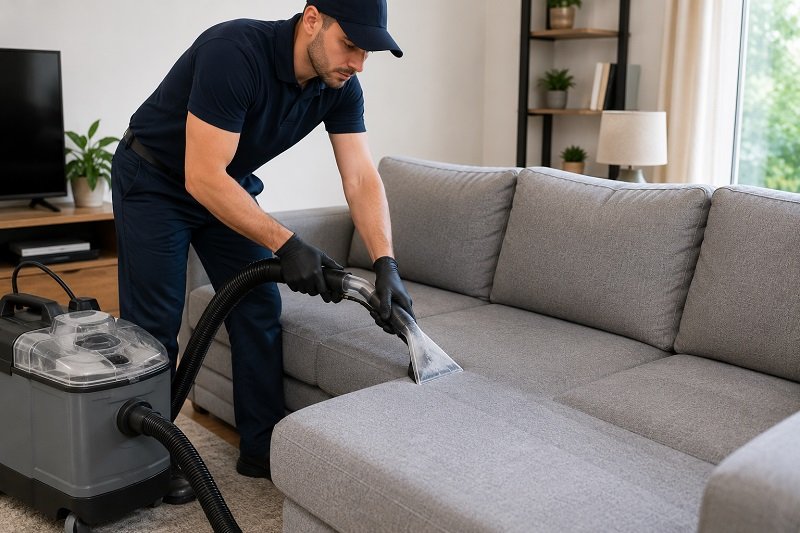
Beyond the annual scheduled service, there are specific situations where calling a professional is the correct immediate response rather than attempting home cleaning first.
The furniture has an X cleaning code and has accumulated odors or visible soiling that vacuuming alone cannot resolve.
A stain is large, has already dried, or has been treated without success two or more times at home. Repeated failed treatments weaken the fabric.
The furniture has been exposed to flooding, sustained heavy moisture, or visible mold growth. These require specialist-grade extraction and antimicrobial treatment.
The fabric is a delicate specialty material such as silk, antique textile, or high-end velvet that you are not confident treating yourself.
The piece has significant value, either monetary or sentimental, that makes the risk of incorrect home treatment unacceptable.
Final Thoughts
What is upholstery? It is the difference between a furniture frame and a piece of furniture you actually want to sit on. It is the layers of craft, material, and engineering that transform rigid structure into everyday comfort.
What is furniture upholstery in practical terms for a homeowner? It is a significant investment in the quality and comfort of your living space. It deserves to be chosen carefully based on how it will actually be used, maintained consistently with the right routine, cleaned properly when stains occur and on a regular schedule, and eventually replaced thoughtfully when the time comes.
The principles covered in this guide apply whether you are choosing upholstery for a new sofa, maintaining a headboard, cleaning a dining chair after a spill, or deciding whether an old armchair is worth reupholstering. Understanding what upholstery is at a fundamental level makes every decision downstream easier, cheaper, and better.
Vacuum weekly. Address spills immediately. Follow the cleaning code. Use the minimum moisture needed. Dry completely. Schedule a professional clean annually. These habits alone will keep upholstered furniture looking genuinely good for years beyond the point where neglected pieces would need replacement.
Frequently Asked Questions About Upholstery
What is upholstery exactly?
Upholstery is the complete system of soft materials used to cover and pad furniture. It includes the outer fabric covering, the cushion filling or foam padding underneath, and the suspension layer of springs or webbing that supports the structure. The term applies to sofas, chairs, headboards, ottomans, outdoor cushions, dining chairs, car seats, and any other item where a structural frame is covered with soft layers for comfort and appearance.
What is furniture upholstery made of?
Furniture upholstery is made from four main layers. The rigid frame gives the piece its shape and structural strength. The suspension system of springs or webbing creates bounce and support. The padding and foam filling determines comfort and firmness. The outer fabric covering forms the visible and tactile surface. Each layer plays a distinct role in the overall function of the piece.
What is the best upholstery fabric for a sofa?
The best upholstery fabric for a sofa depends on how the sofa will be used. For family rooms with children and pets, performance fabrics, microfiber, and leather offer the best combination of durability and easy cleaning. For formal or low-use rooms, velvet, linen, and bouclé are beautiful options. For general use in most homes, a tightly woven polyester blend or a performance fabric with a high rub count provides the best balance of appearance and practicality.
How do I clean upholstery at home?
Clean upholstery at home by first checking the cleaning code on the care label. Vacuum the surface thoroughly. Apply baking soda for odor removal and leave for 20 minutes before vacuuming. Spot test your cleaning solution on a hidden area. Treat individual stains by their type using appropriate solutions. Clean the full surface with a damp cloth and mild soap solution for W and WS coded fabrics. Rinse with a plain water-dampened cloth. Allow to air dry completely.
How often should upholstery be cleaned?
Upholstery should be vacuumed weekly, deep cleaned at home every three to six months, and professionally cleaned once a year. Spills should be treated immediately regardless of schedule. The exact frequency depends on usage level, whether pets and children are present, and the specific fabric type.
Can I clean upholstery with just baking soda and vinegar?
Baking soda is highly effective for odor removal and is safe on all fabric types. White vinegar diluted equally with water is effective on light stains and surface bacteria on W and WS coded fabrics. Together they address mild soiling and odors well. For grease stains, protein stains, or deep soiling, a mild soap solution or an enzyme cleaner will be more effective.
What is the difference between upholstery and reupholstery?
Upholstery refers to the existing soft covering on furniture. Reupholstery is the process of removing the old fabric and materials and replacing them with new ones. Reupholstery is worth considering when the furniture frame is still structurally sound but the covering has worn out, been damaged, or is no longer visually appealing.